
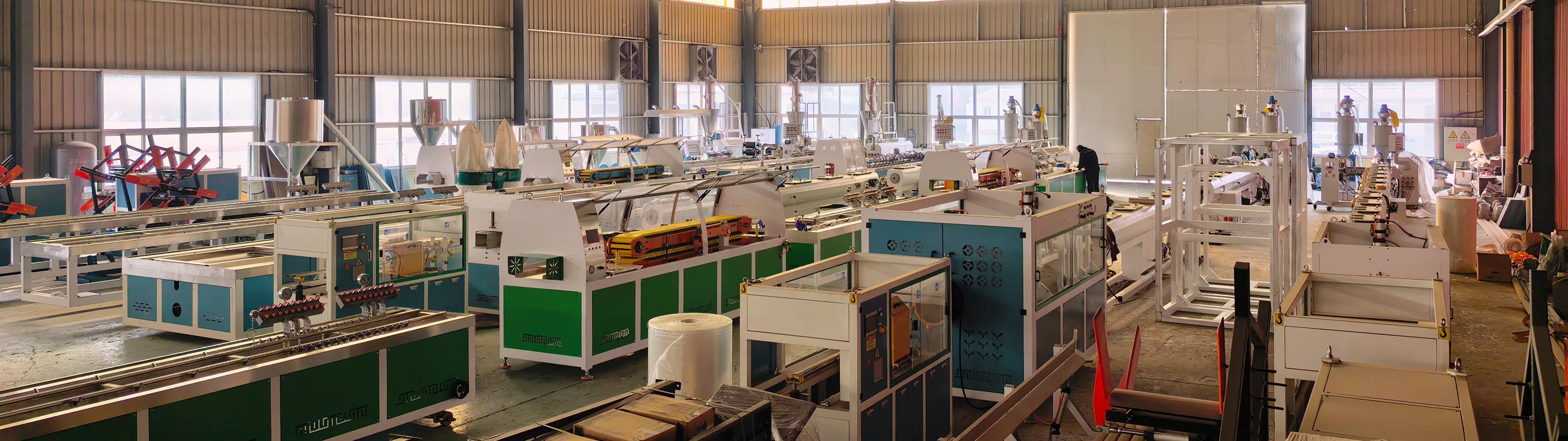
Temperature setting of WPC door frame extrusion line
Temperature Parameter Setting for PVC Wood-Plastic Door Frame Extrusion Line
The Yongte Wood-Plastic WPC Door Frame Extrusion Line is specialized equipment designed for manufacturing PVC-based wood-plastic composite door frames. By combining PVC plastic with fine wood powder and employing microfoaming molding technology, the final product features robust structural integrity, exceptional durability, lightweight construction, and ease of transportation and installation. However, in actual production operations, inaccurate or improper temperature parameter settings by operators often result in quality defects in the output profiles, failing to meet compliance standards. To address this issue, Yongte's technical team has compiled detailed temperature calibration guidelines based on extensive practical experience, providing actionable reference for manufacturing processes.
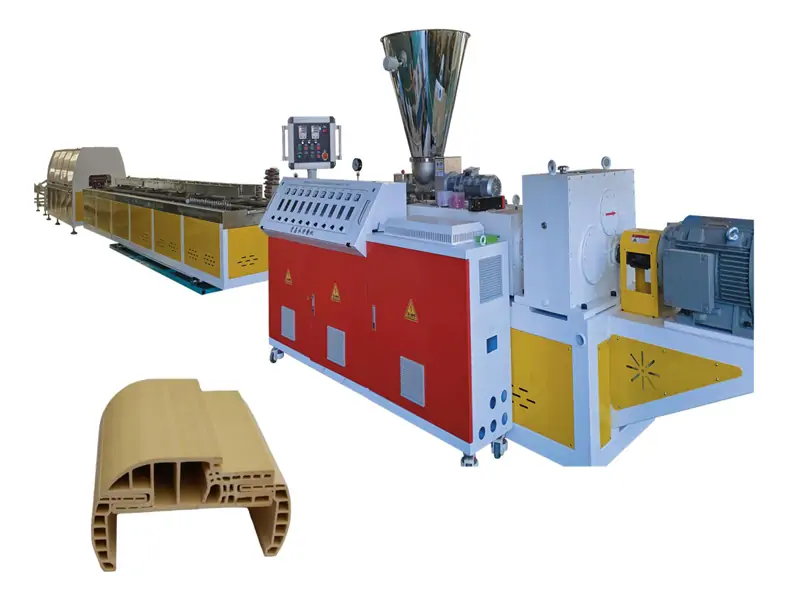
Temperature control during extrusion processing for wood-plastic composite (WPC) micro-cellular door frames (currently dominated by PVC-based materials) follows these core principles: The feeding hopper area should maintain relatively low temperatures to prevent premature foaming reactions. The plasticizing zone requires gradual and steady temperature increases to ensure complete material melting and uniform mixing. Meanwhile, temperature adjustments at the die head and mold sections are essential to effectively regulate the foaming process while maintaining surface finish and overall appearance quality of the profiles.
1. Reference temperature settings for conical twin-screw extruders (the most commonly used equipment type in PVC wood-plastic door frame production)
Temperature values are listed from the hopper to the machine head along the material flow direction, with units in degrees Celsius.
|
Heating zone |
Temperature range |
Mechanism of Action and Key Control Points |
|
Barrel Zone 1 (Feed / Chute Section) |
135–145 |
Low-temperature preheating prevents premature decomposition of anti-foaming agents and material bridging |
|
Barrel Zone 2 (Compressed segment) |
155–165 |
Initiate melting and mixing, gradually increasing the degree of plasticization |
|
Barrel Zone 3 (plasticization /homogenization section) |
165–175 |
Fully plasticized, uniformly shear-depressed, and approaching the optimal decomposition temperature of the foaming agent |
|
Barrel Zone 4 (Measurement Section) |
170–180 |
Stabilize melt pressure and fluidity to prepare for mold entry |
|
Confluence core/transitional segment |
160–165 |
Slightly cool to inhibit premature foaming and ensure smooth mold entry |
|
Mold (die head / gate die) |
170–180 |
Control of flow rate and foaming rhythm: slightly higher for the outer layer (175–180) and slightly lower for the inner layer (170–175) |
II. Key Regulatory Principles and Precautions (Please read carefully and comply)
1. Prescription components determine temperature benchmarks
When the proportion of wood flour is relatively high or the amount of filler added is substantial, the overall temperature should be increased by approximately 5–10°C.
If foaming agent AC is the primary foaming component, it is recommended to maintain the temperature of Zone 3 and Zone 4 between 170–175°C to ensure stable foaming process.
When pursuing higher foaming ratios and lower product densities, it is advisable to adopt lower values within the temperature range, while simultaneously reducing the mold temperature appropriately.
2. Judgment and adjustment based on product appearance and cell structure
If roughness or pitting appears on the profile surface, it typically indicates low temperature or insufficient plasticization. In such cases, the set temperature for zones 2 to 4 should be appropriately increased.
If the product exhibits issues such as bubbling, perforation, or deformation, these are often caused by excessive temperature or rapid foaming rate, necessitating corresponding temperature adjustments in Zone 3, Zone 4, and the mold.
If the surface gloss is poor and the internal pores are coarse and uneven, it may be related to uneven temperature distribution in the mold or insufficient pressure at the die head. The mold heating and pressure control should be inspected.
3. Key control points during startup warm-up and production stabilization phases
-Adopt a stepwise heating method: First maintain each temperature zone at approximately 140°C for about 20 minutes, then gradually increase to the process-set temperature and continue maintaining constant temperature for 10–15 minutes.
The screw speed is generally maintained at 18–25 revolutions per minute (rpm) and should be coordinated with temperature settings to ensure sufficient residence time of the material within the barrel for achieving uniform plasticization.
III. Common startup temperature reference settings (can be directly used for initial debugging)
|
Heating zone |
Temperature(Unit:°C) |
|
Barrel Zone 1 |
140 |
|
Barrel Zone 2 |
160 |
|
Barrel Zone 3 |
170 |
|
Barrel Zone 4 |
175 |
|
Confluence core |
162 |
|
Mold body |
175 |
|
Mould gate |
172 |
After observing the state of extruded strips, surface quality, and measuring product density, fine adjustments of ±2~3°C can be made for each temperature zone to optimize the production process.