
What innovative possibilities for WPC extrusion technology in the future?
What innovative possibilities for WPC extrusion technology in the future?
Future innovations in wood-plastic composite (WPC) extrusion will concentrate on six key areas: the development of bio-based raw materials, enhanced interfacial bonding strength, multi-layer co-extrusion structures, intelligent and low-carbon manufacturing processes, functional integration, and high-end applications. The overall goal is to transform WPC from a "low-end building material" into a combination of high-strength structural materials and green functional materials.
1、Raw material system: high bio-based content, high filler content, fully biodegradable
High wood fiber content (>80%) exceeds the conventional upper limit of 65%, achieving both strength and fluidity under high filling conditions through dynamic plasticization and surface nanomodification, significantly reducing costs and carbon emissions.
The fully biodegradable WPC (PLA/PBAT + wood powder) addresses the non-biodegradability issue of traditional PE/PP-based materials, is compostable with zero plastic residue, and is suitable for single-use packaging, horticulture applications, and prefabricated components.
Comprehensive utilization of agricultural and forestry waste: bamboo fibers, straw, fruit shells, and hemp fibers serve as alternatives to wood flour; **Micro-nano fibrillation (MNF)** enhances interfacial bonding, increasing strength by 30%–50%.
A high blending ratio (≥50%) of recycled plastics, combined with multi-stage purification and compatibilization technologies, enables stable blending of HDPE/PVC/PP at 35%–50%, reducing the carbon footprint to negative levels.
2、Interface modification: Molecular-level strengthening and long-term weather resistance
The nanointerfacial layer (silane/titanate + nano-SiO₂/cellulose) establishes a three-dimensional interlocking structure of "wood powder–nanolayer–plastic," enhancing interfacial strength by 5–10-fold and significantly improving water resistance, creep resistance, and UV resistance.
In situ graft copolymerization imparts hydrophobic groups to the surface of lignocellulose fibers during extrusion, fundamentally resolving the "hydrophilic–hydrophobic" incompatibility and enhancing long-term stability.
Biological compatibilizers (tannins, lignin derivatives) replace petrochemical additives such as maleic anhydride, featuring a fully biobased formulation that enhances environmental sustainability and interfacial adhesion.
3、Co-extrusion structure: multi-layer composite with functional gradient
Nucleus-shell co-extrusion (CoWPC)
Core layer: high wood powder content (70%–80%), low cost, and high rigidity;
Surface layer: low-molecular-weight wood powder / pure plastic + weather-resistant, antibacterial, and wear-resistant modified coating;
Effects: Weather resistance enhanced 5–10 times, spray-free application, service life exceeding 20 years; widely used in outdoor flooring and wall panels.
Multicomponent co-extrusion (WPC + solid wood/metal/foam layer): When combined with WPC–LVL (laminate veneer lumber), the interface strength increases by 27–56 times, enabling its use as load-bearing structural components in prefabricated buildings and rail transit systems.
The gradient extrusion process utilizes a gradual variation in wood powder content and composition across the cross-section, achieving "high strength on one side and weather resistance on the other," making it suitable for complex operating conditions.
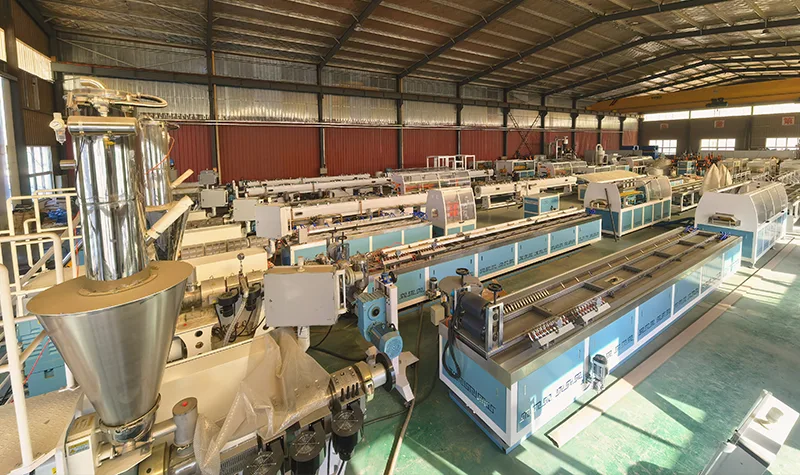
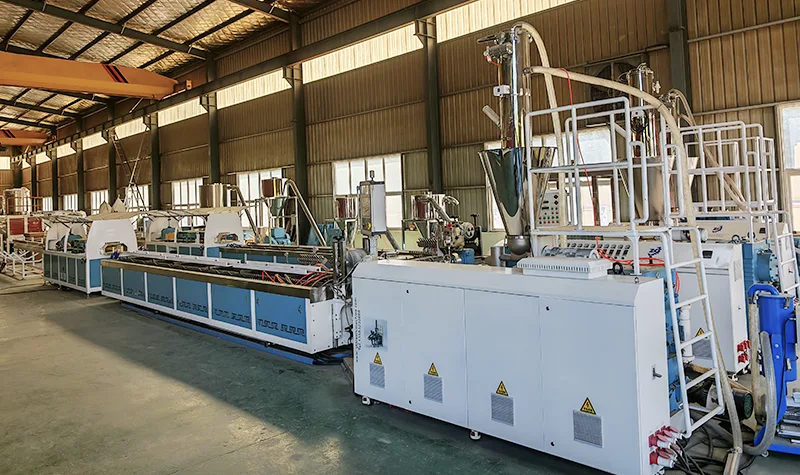
4、Extrusion process: efficient, energy-saving, intelligent, and precise
One-step extrusion (eliminating the granulation step) allows direct dry/wet feeding, reducing energy consumption by 30% and costs by 40%, making it suitable for high-filled systems.
Double-stage/planetary screw mixing system with strong shear and high dispersion capability, achieving a first-pass qualification rate of 96.7% – essential for high-filling applications and nano-modification processes.
Intelligent cooling and setting process (spraying + coolant injection + vacuum): The third-generation system achieves a COP of 3.41 (compared to 1.84 for traditional water cooling), with a 27.9% improvement in cooling efficiency and a closed-loop water recycling rate of ≥90%.
AI + Digital Twin enables end-to-end control with over 200 sensors monitoring temperature, pressure, and torque in real time; AI automatically optimizes parameters; the digital twin simulates flow and molding processes; energy consumption per ton is reduced to 395 kWh, with a yield rate approaching 100%.
Micro-foaming extrusion (chemical/physical foaming): reduces density by 20%–40%, enhances thermal and acoustic insulation, and lowers costs; structural foaming WPC is used for lightweight building materials and automotive interiors.
5、Functionalization: From structural materials to multifunctional materials
Weather-resistant/anti-aging properties: The surface is treated with UV531, HALS, and nano-TiO₂, extending the outdoor service life from 5 years to 15–20 years.
Flame-retardant (Grade A/UL94 V0); halogen-free flame retardant (ammonium polyphosphate, lignin-based flame retardants), compliant with building fire safety requirements.
Antibacterial/anti-fungal properties, modified with nano-silver, zinc, and chitosan, suitable for use in kitchen and bathroom applications, medical settings, and food contact scenarios.
Thermal/Conductive/Electromagnetic shielding: Incorporates graphite, carbon nanotubes, and carbon fibers for use in heat dissipation components, anti-static flooring, and shielding wall panels.
Self-healing/shape memory: Incorporating microcapsule repair agents or thermally induced memory resins to enhance durability and safety.
6、Application Upgrade: From Outdoor Flooring to High-End Structural and Transportation Solutions
Prefabricated building structures utilize structural-grade WPC (with strength ≥30 MPa) for beams, columns, wall panels, and floor slabs, offering lightweight construction, maintenance-free operation, and rapid installation.
Automobile/Track Transportation: Interior components (door panels, instrument panel frame) and exterior components (bag racks, footrests); features 30% weight reduction, low volatile organic compounds (VOC), and recyclability.
High-end furniture free of formaldehyde, waterproof and scratch-resistant, replacing solid wood and particleboard, suitable for outdoor and humid environments.
New Energy and Environmental Protection: Photovoltaic frames, wind turbine blade core materials, marine aquaculture facilities; resistant to salt spray, aging, and low carbon emissions.
7、Key Challenges and Pathways to Breakthrough
Key limitations: poor fluidity under high filling conditions, weak interfacial bonding, susceptibility to long-term creep, inadequate weather resistance, and relatively high cost.
Breakthrough: Nano-interface modification + one-step intelligent extrusion + core-shell co-extrusion + bio-based formulation, simultaneously addressing performance, cost, and environmental concerns.
sum up
Over the next 5–10 years, WPC will evolve from a simple composite of wood powder and plastic to a comprehensive upgrade encompassing bio-based formulations, nanoscale reinforcement, multi-layer functionality, smart manufacturing, and high-end applications, establishing itself as a mainstream structural and functional material characterized by environmental sustainability, low carbon footprint, high strength, durability, versatility, and cost-effectiveness. The market size is projected to grow at an average annual rate of 8%–12%.