
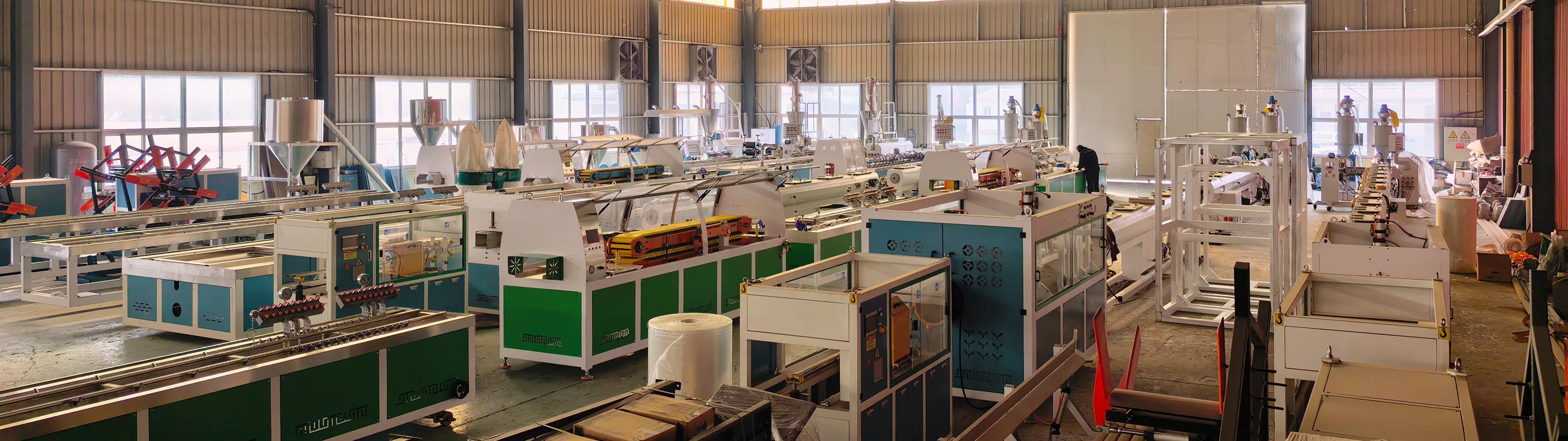
Solution for Uneven thickness of WPC door extrusion line
What should I do if the extruded wall thickness of WPC door is uneven?
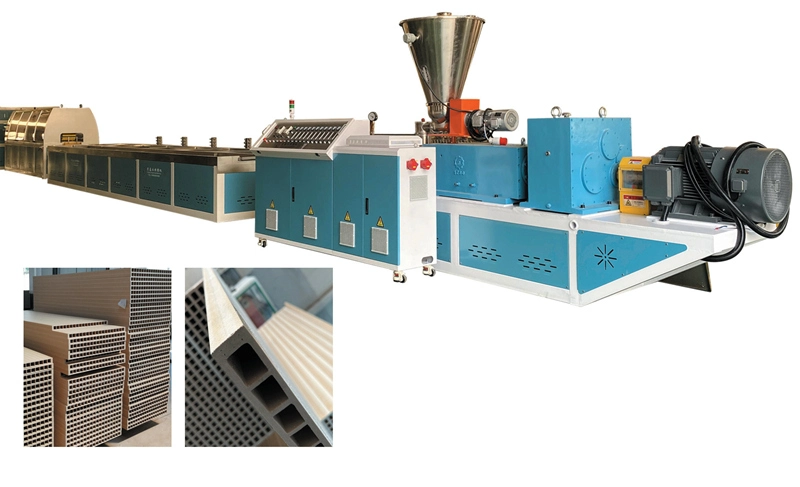
As a professional manufacturer specializing in WPC door extrusion lines, Yongte Company is dedicated to providing customers with one-stop solutions, from equipment supply to comprehensive technical support. We offer not only high-performance production line systems but also professional on-site installation and meticulous commissioning services. Many wood-plastic door manufacturers encounter issues such as uneven extruded wall thickness. Our expert engineers can promptly diagnose these problems by analyzing equipment operating parameters and material properties to identify the root cause. Subsequently, targeted adjustments are implemented through a systematic commissioning process. This ensures uniform wall thickness and stable product dimensions, significantly improving both product quality yield and production efficiency. The following commissioning methods are provided for customer reference.
I. Scope of Application
PVC base wood-plastic door panel/special-shaped profile extrusion production line, designed to address issues such as uneven thickness on one side, vertical thickness variation, localized thickness differences, or overall thickness imbalance, with adjustments made in priority order.
II. Tiered Debugging Process (Priority Order: Die → Temperature → Setting → Traction → Raw Material)
Step 1: Adjust die clearance (highest priority; preferred for local unevenities)
The equipment operates at low speed; shut down and lock it for safe operation.
At each point along the entire circumference of the mouth mold, measure the actual clearance every 5–10 cm using a feeler gauge.
Adjustment rules: If the wall thickness is excessive, tighten the bolts (by 15°–30°) to reduce the clearance; if the wall thickness is insufficient, loosen the bolts (by 15°–30°) to increase the clearance.
Make a single fine adjustment; after adjustment, start the device and let it stabilize for 3–5 minutes before retesting. Do not make large adjustments in one go.
Quality standard: Total weekly gap deviation ≤ 0.05 mm
Step 2: Fine-tune the zone temperatures (if temperature distribution remains uneven after gap correction)
Excessive local wall thickness: Corresponding regions exhibit a slight temperature increase (2–3°C) and reduced melt flow rate.
Reduced local wall thickness: Corresponding area exhibits mild cooling (2–3°C), increasing melt resistance
Top/bottom/Left/right overall thickness variation: Adjust the temperature of the corresponding zone on the die head simultaneously, keeping the temperature difference within 5°C
Step 3: Finalize System Diagnosis and Correction
Vacuum deficiency: Clean the vacuum circuit and filter, and restore it to standard vacuum level; for localized collapse or thinning, apply additional vacuum pressure only to those areas
Cooling anomaly: Clear blocked water pipes and increase cooling water flow in thin sections
Position Offset: Realign the centers of the die and setting mold to prevent unilateral stress
Step 4: Match traction and extrusion speeds (prioritize overall thickness consistency)
The overall thickness of the product is substantial: slightly increase the traction speed / reduce the main screw rotation speed / adjust the feeding rate
The overall thickness of the product is reduced: slightly lower traction speed / increased main screw rotation speed / higher feed rate
The wall thickness varies intermittently: reduce the main unit speed, maintain constant traction tension, and ensure stable linear velocity.
Step 5: Raw Material and Blending Adjustment (to be performed if the above adjustments prove ineffective)
Moisture absorption in flour powder / uneven particle size: Re-dry and sieve; replace with qualified batch of raw materials.
Poor liquidity: Supplement with appropriate amounts of both internal and external lubricants.
Uneven mixing: Extend the hot-mixing/cold-mixing time to ensure material homogeneity.
III. Comparison Table of Common Fault Symptoms, Causes, and Quick Solutions
|
Fault phenomenon |
Core Reason |
On-site Handling Plan |
|
Thicker on top, thinner at the bottom |
There is a large gap on the upper side of the die mold, and the temperature at the top of the mold head is elevated. |
Tighten the upper bolts of the die mouth; reduce the temperature in the upper region of the die head by 2–3°C. |
|
Thicker on the bottom, thinner on top |
The gap beneath the die mold is large, and the temperature at the lower part of the die head is elevated. |
Tighten the bolts on the lower side of the constriction die; reduce the temperature in the lower region of the die head by 2–3°C. |
|
Thicker on the right, thinner on the left / Thicker on the right, thinner on the left |
Unequal left-right gaps of the die mold, temperature difference between the left and right mold heads, and displacement of the mold body |
Tune the corresponding side bolts; correct the coaxiality of the die head; balance the left and right temperatures |
|
Local punctate uneven thickness distribution |
Material accumulation in the flow channel, partial blockage of the die opening, and blockage of vacuum pores |
Shut down to clean the die/mold runner; clear the vacuum holes of the setting mold |
|
The entire board is generally quite thick. |
High extrusion volume and slow drawing speed |
Increase the traction speed or decrease the main unit speed |
|
The entire board is generally quite thin. |
Low extrusion volume and fast drawing speed |
Lower the traction speed or increase the main machine speed. |
|
Periodic fluctuations in wall thickness |
Unstable feeding, traction slippage, and fluctuating screw speed |
Check the feeder; adjust the pressure of the traction rubber roller; tighten the transmission components. |
IV. Contraindications & Precautions for the Procedure
It is strictly prohibited to make excessive turns of the die bolt in a single operation, as this may cause deformation of the profile, wave edges, or tearing.
The temperature adjustment should not exceed 3°C per operation; make repeated minor adjustments only. Significant temperature changes across different ranges are prohibited.
Before debugging, ensure the die and setting die are aligned; otherwise, debugging will be ineffective.
Before each shift, clean the vacuum air passages, water passages, and the surface area of die molds to prevent abnormal wall thickness in later stages.
After changing the raw material batch, prioritize retesting temperature and clearance before resuming normal production.
V. Standards for Successful Acceptance
Full plate wall thickness deviation ≤ ±0.2 mm
The profile surface is smooth, free from depressions, bulges, or wave patterns.
Production was maintained continuously for 30 minutes with no significant fluctuations in wall thickness.