
Solution for Dimensional Deviation, Warpage and Deformation in WPC Door Production
Solution for Dimensional Deviation, Warpage and Deformation in WPC Door Production
Abstract
Wood-Plastic Composite (WPC) doors have emerged as a mainstream product in the modern door and window manufacturing industry by virtue of their outstanding advantages including environmental friendliness, moisture resistance, corrosion resistance, and low comprehensive production cost. Nevertheless, dimensional deviation, warpage and irreversible deformation are three prevalent quality defects during the extrusion and molding process of WPC doors. These problems not only reduce the surface flatness and overall appearance of finished products, but also directly affect subsequent assembly efficiency, product service life and customer satisfaction. Based on years of on-site production experience and technical research, professional engineers from Yongte summarize targeted adjustment and correction solutions for the above three defects, aiming to provide reliable technical references for WPC door manufacturers to optimize production processes and upgrade product quality.
1. Introduction
WPC materials are compounded with plant fiber, thermoplastic resin, functional additives and other raw materials through high-temperature melting and extrusion molding. Affected by multiple factors such as raw material formula ratio, extrusion temperature, cooling system, traction speed and cutting process, semi-finished and finished WPC door products are prone to unstable overall dimensions, unilateral or bilateral warping, and structural deformation. Different from traditional solid wood doors and PVC doors, WPC doors have complex internal structural stress characteristics. Blind debugging of a single process parameter cannot completely eliminate quality defects; systematic optimization from molding, cooling to post-processing is required. This paper analyzes the root causes of common defects and puts forward feasible correction strategies.
2. Causes and Correction Solutions of Common WPC Door Defects
2.1 Dimensional Deviation
2.1.1 Defect Causes
Dimensional deviation refers to the error between the actual length, width and thickness of WPC doors and the standard design values, which mainly occurs in the cutting stage and extrusion molding stage. The core inducing factors include uneven cooling of profiles, fluctuating traction speed, unreasonable structural design of the shaping system, and errors in manual or mechanical cutting. Excessive dimensional errors will lead to poor matching during door frame assembly, resulting in gaps, door jamming and other after-sales problems.
2.1.2 Professional Correction Measures
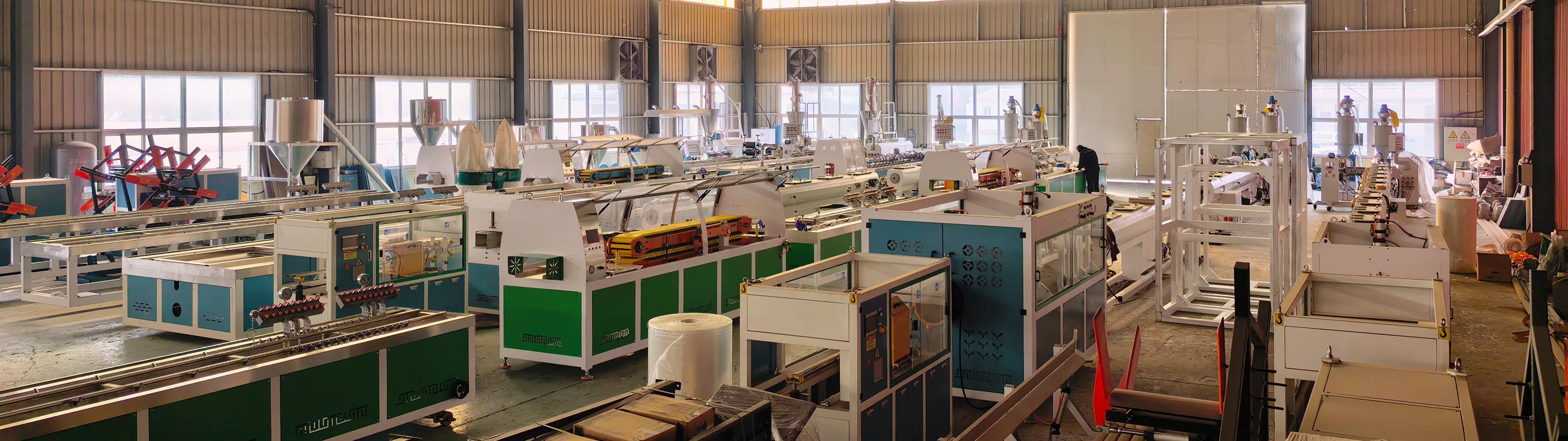
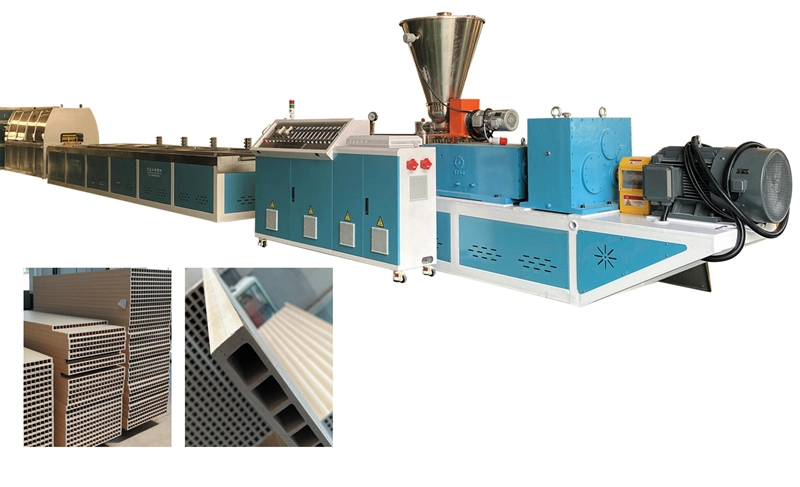
According to Yongte’s technical team, a combined process of vacuum shaping, water cooling circulation and stable traction control is the core to control dimensional accuracy of WPC doors. First, the vacuum shaping system is adopted to constrain the outer contour of extruded WPC profiles in real time, so as to avoid profile expansion or shrinkage caused by thermal expansion and cold contraction. Second, the circulating water cooling device is configured to realize uniform and gradual cooling of the inner and outer layers of the door panel, eliminate local shrinkage differences, and stabilize the basic size of the profile after molding.
In addition, it is essential to match a high-precision constant-speed traction device to avoid size jitter caused by fast and slow traction. Cooperated with optimized fixed-length cutting equipment, the whole production line can realize the cutting accuracy controlled within ±1 mm, which fully meets the high-standard assembly requirements of finished WPC doors.
2.2 Panel Warpage
2.2.1 Defect Causes
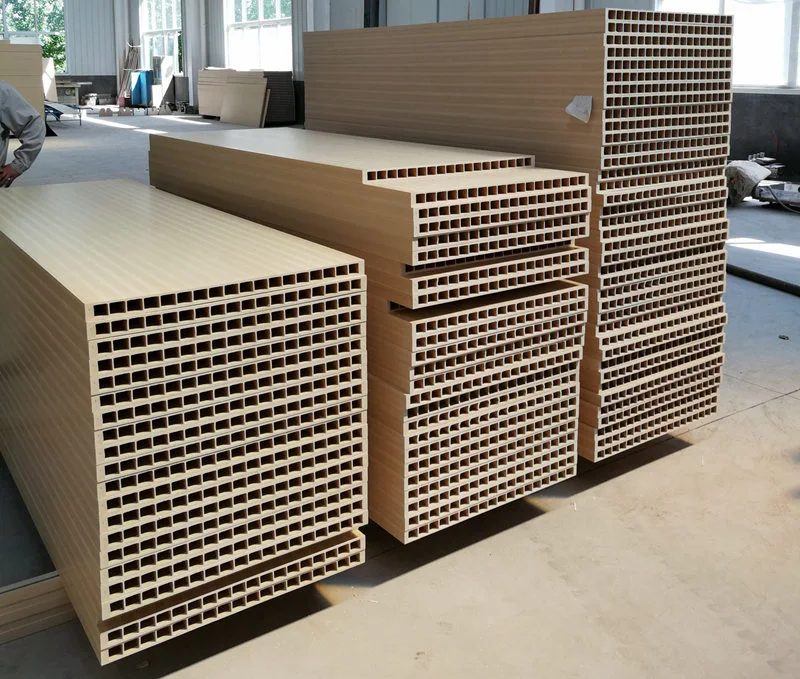
Warpage is one of the most frequent defects of WPC doors, mainly manifested as arc bending of the door panel in the horizontal or vertical direction. The main root causes cover asymmetric cooling speed on both sides of the profile, inconsistent gap of die lip of the extrusion mold, and unstable traction tension. Asymmetric cooling will lead to inconsistent shrinkage stress on the upper and lower surfaces of the door panel; unreasonable die lip gap will cause uneven discharge of composite materials; and frequent fluctuation of traction speed will aggravate the unbalanced stress distribution of semi-finished products.
2.2.2 Professional Correction Measures
To solve the warpage problem fundamentally, manufacturers need to make synchronous optimization from cooling system, mold structure and traction parameters. Firstly, implement balanced cooling management, adjust the water flow and temperature of the cooling water channel on both sides of the shaping mold, ensure the synchronous cooling speed of the upper and lower parts of the WPC door panel, and reduce the stress difference generated in the cooling stage.
Secondly, regularly detect and calibrate the die lip gap of the extrusion mold to ensure the gap symmetry on the left and right as well as upper and lower sides, so that the molten WPC materials can be discharged evenly, and the density of all parts of the door panel remains consistent. Finally, maintain the constant operating speed of the traction unit, set a reasonable tension threshold, avoid sudden acceleration and deceleration, and prevent external traction force from causing irreversible bending warpage of the uncooled cured door panel.
2.3 Structural Deformation
2.3.1 Defect Causes
Different from surface warpage, structural deformation belongs to internal permanent damage of WPC door profiles, including indentation, torsion and overall collapse. This defect is mainly caused by unreasonable cooling path design, residual internal stress inside the material, and unbalanced raw material formula. Unreasonable cooling paths will lead to excessive residual stress inside the profile; mismatched ratio of plant fiber, plastic matrix and additives will reduce the toughness and structural stability of WPC materials, making finished products prone to deformation under external temperature changes and external force extrusion.
2.3.2 Professional Correction Measures
Yongte engineers propose three core optimization directions to solve structural deformation: optimizing cooling paths, releasing residual internal stress, and adjusting raw material formula. In terms of cooling paths, redesign the layout of internal and external cooling water channels of the shaping equipment, adopt the graded cooling mode of pre-cooling, constant-temperature shaping and final cooling, realize slow stress release while cooling molding, and avoid excessive internal stress accumulation.
For internal stress regulation, add a stress relief aging section after the traction process, place the initially molded door panel in a constant-temperature and constant-humidity environment for a certain period to eliminate residual stress. In terms of formula optimization, adjust the mixing ratio of wood powder, plastic particles, coupling agent and stabilizer, improve the interfacial bonding force between plant fiber and thermoplastic resin, enhance the overall toughness and anti-deformation ability of composite materials, and fundamentally reduce the probability of structural deformation.
3. Conclusion
Dimensional deviation, warpage and deformation are key bottlenecks restricting the quality upgrading of WPC door products, and the occurrence of various defects is interrelated and affected by multiple production links. In actual production, manufacturers should not only rely on single parameter debugging, but also build a full-process quality control system covering raw material formula, extrusion molding, vacuum shaping, water cooling cooling and constant-speed traction.
Adopting the high-precision production process of vacuum shaping + water cooling + stable traction to control dimensional errors, matching balanced cooling and symmetric die structure to restrain warpage, and optimizing cooling paths and material formulas to eliminate structural deformation can effectively solve the above common quality problems. For WPC door enterprises, standardized process parameter setting and daily equipment maintenance are also important prerequisites to maintain long-term stable product quality.
Previous:Reason of Cracking in WPC Decking