

What should the designed installation gap be for the tongue-and-groove joints of WPC fence panels?
WPC Fence Panel Mold Tongue & Groove Design and Trial Run Requirements
1. Mold Clearance Design Standard
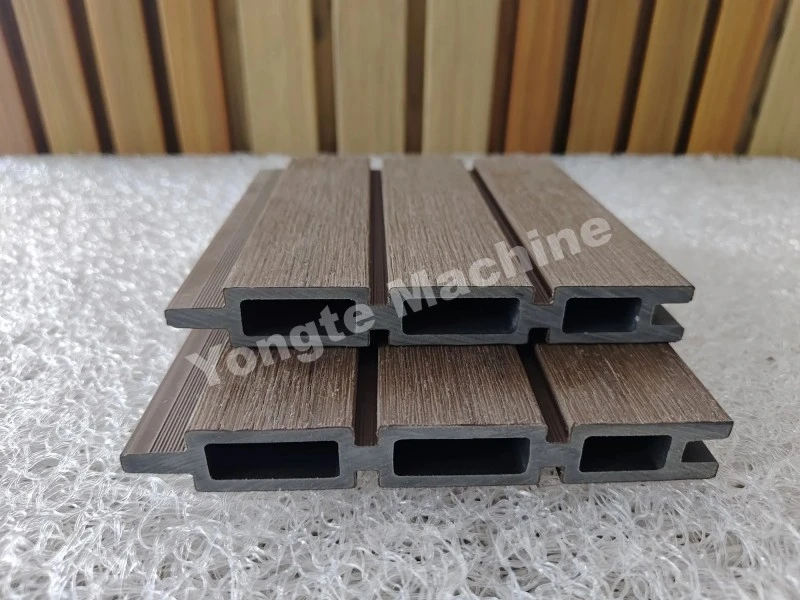
- The finished single-side mating clearance of the tongue and groove shall be designed as 0.40~0.50 mm. This clearance range ensures smooth assembly while preventing excessive play or binding during thermal expansion and contraction in service conditions.
- For high wood flour loading formula (≥70%) and co-extruded solid fence panels, the single-side clearance shall be set to 0.45~0.50 mm. This tighter tolerance accounts for the reduced dimensional stability and higher thermal expansion coefficient typically exhibited by high wood flour content composites, ensuring reliable interlocking performance across varying environmental conditions.
- Strict tolerance limit: The finished single-side clearance shallnever be less than 0.35 mm and never exceed 0.55 mm.Exceeding the upper limit may lead to visible gaps and compromised structural integrity, while falling below the lower limit risks jamming during installation or in-service deformation due to restricted movement. Mold designers must verify clearance dimensions using calibrated measurement tools after mold machining and prior to trial runs to ensure compliance with these specifications. Additionally, mold wear over time must be monitored, as progressive erosion of the tongue or groove features can gradually shift clearances outside the acceptable range, necessitating periodic maintenance or rework.
- Insufficient clearance will cause tenon locking and panel bulging due to thermal expansion in high temperature. Excessive clearance will lead to panel shaking, wind vibration noise and uneven joint appearance.
2. Draft Angle Requirement
All tongue and groove matching surfaces shall be designed with a 1°~1.5° draft angle. A zero-degree right-angle structure is prohibited. This ensures smooth demolding, avoids surface scratching, profile distortion and dimension deviation.
The draft angle must be consistently applied along the entire length of the tongue and groove to maintain uniform release characteristics during ejection. Failure to incorporate adequate draft may result in localized stress concentrations, which can induce micro-cracks or permanent deformation in the molded part. Additionally, the direction of the draft should align with the mold opening direction to maximize its effectiveness.
3. Shrinkage Compensation Requirement
The mold cavity size must reserve compensation for WPC cooling shrinkage. The standard shrinkage rate is 0.8%~1.2%.
Final acceptance is based on the dimension of fully cooled finished profiles, not the original mold cavity size.

4. Trial Run & Acceptance Criteria
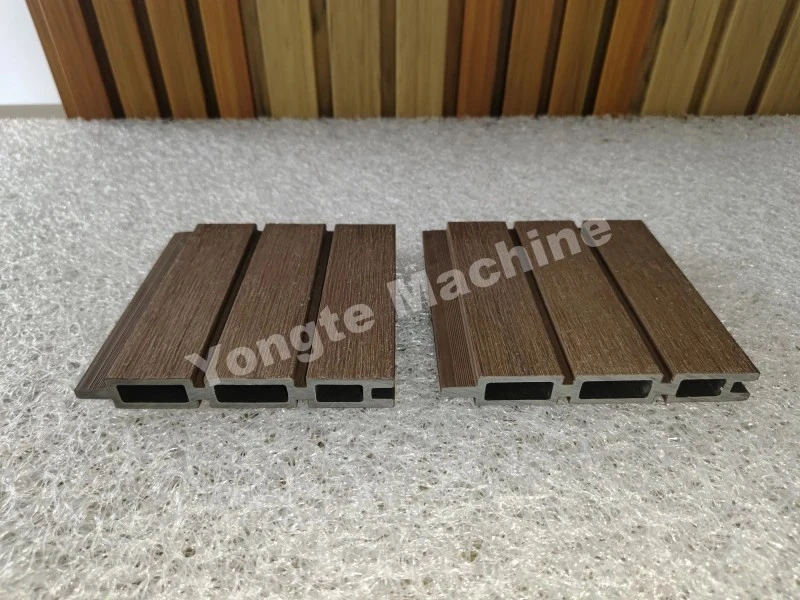
Finished panels shall be easily aligned and fully inserted by gentle rubber hammer tapping. No hard pounding, no jamming, no scraping or edge damage during assembly.
After assembly, no obvious lateral play or shaking. The structure shall remain stable and noise-resistant under outdoor wind conditions.
Random inspection of three continuously extruded profiles is required. The clearance deviation within the same batch shall be controlled within ±0.05 mm.
Finished samples shall pass high and low temperature expansion simulation tests to ensure no tenon locking after thermal expansion.